A New Lease on FI Life
I had a near-job experience.
Like a near-death experience, except instead of my life flashing before my eyes, it was my old commute. I went through the whole thing. Full interview process, a real offer, the works. I pictured myself accepting it. I got close enough to feel the weight of it settling onto my shoulders. And then I said no.
Turning it down gave me something I didn't expect. Not relief exactly. More like a renewed appreciation for the life I already have.
The opportunity was at the University of Rhode Island. Which is what made it hard.
URI is my alma mater. I was there from 2005 to 2009, stuck around through 2010, taught there, worked there. The campus has always felt like home. There's an energy on a college campus that's hard to describe and harder to match. The students keep it young and alive. The faculty and staff make it feel like a community. I love that place.
Going back had been part of the plan for a long time. When I was in grad school and wanted to stay on at URI, one of the directors there told me to go make my money first. "Go make your money. Once you've had enough, come back." I didn't want to hear it at the time (I liked higher ed, I wanted to stay), but I understood it. So that became the game plan. Go out into the corporate world, build the career, earn the money, and come back to URI someday when maximizing income wasn't the point anymore.
I'm too reflective to let a line like that go. It lived in my head for fifteen years. So when this role came up, it felt like the plan finally closing the loop.
The job itself was lower-key than the corporate business manager roles I'd been doing. It paid substantially less. But good benefits, a real community, better people. And the whole process felt more human than any corporate interview I'd ever been through.
In corporate, the offer stage is a transaction. Here's the offer, here are the terms, tell us your number, we can do this, we can't do that. With URI it was a conversation. I came back with questions about hours and hybrid flexibility, and my prospective boss just called me. We talked it through like two people trying to figure out whether we could make it work.
When I asked about hybrid days, she didn't hand me a protocol for requesting them. She said we'd figure it out together. Every week we'd stay in touch and sort out which days made sense for each of us to be remote. Not "here's how you file the request," and not a flat no. Just, of course, and we'll work it out. That was the whole vibe.
It didn't feel like a boss talking to a subordinate. It felt like a conversation between future teammates. I could picture working with her, not for her.
Here's the part that really got to me, though. The woman I'd have reported to, I didn't actually know. But she reported to someone I did. The director who told me to go make my money, all those years back, runs the whole building now. This job would have put me back under her, even if only indirectly. Getting to work with her again would have been awesome. That was a big part of the pull.
And it still didn't work.
The role needed more time on campus than our family could absorb. Five days a week, roughly an hour commute each way. Call it ten hours a week in the car before I did a single minute of actual work.
We have three young kids at home, and we homeschool them. Being gone that much of the day means not being there for breakfast, or dinner, or the dishes and the laundry and the hundred small things that keep a house running. And the salary wasn't high enough to buy back that much of my time.
I wanted it. That's the part that made it hard.
Melissa was trying to be supportive, but I could feel her hesitation. She understood how drastic a change it would be, and she wasn't being selfish about it. She was trying to tell me something. I'd assumed the role would be more flexible than it turned out to be, and even with everything they were willing to bend on, it just wasn't right for where we are.
The moment it flipped from maybe to not now, I already had the offer. In my head I was mostly there. I think I'm taking this job. Then I was out pushing the boys on the swings in the middle of a weekday, no desk, no meeting, just me and the boys and the swings, and it landed. If I take this job, I don't get this anymore. Not during the week. That's when it hit me what I'd be giving up, and that I wasn't ready to.
I also realized I was closer to Melissa's read than I'd been admitting, because I was in love with the idea. Back to URI, in a role I'd be good at and actually enjoy. That's a hard thing to see clearly through.
She couldn't be the one to make the call. If she made it, it would sit there and turn into resentment someday. It had to be me. I had to listen to her and be honest with myself at the same time. The night before we talked it through, I already knew. I just needed to arrive at it myself.
When I finally declined, my prospective boss couldn't have been more understanding. Which somehow made it harder. That's the kind of people they are over there. They'll make you feel good about the exact choice they were hoping you wouldn't make. Melissa was probably a little disappointed for me too. I was equally disappointed as I was sure it was the right call.
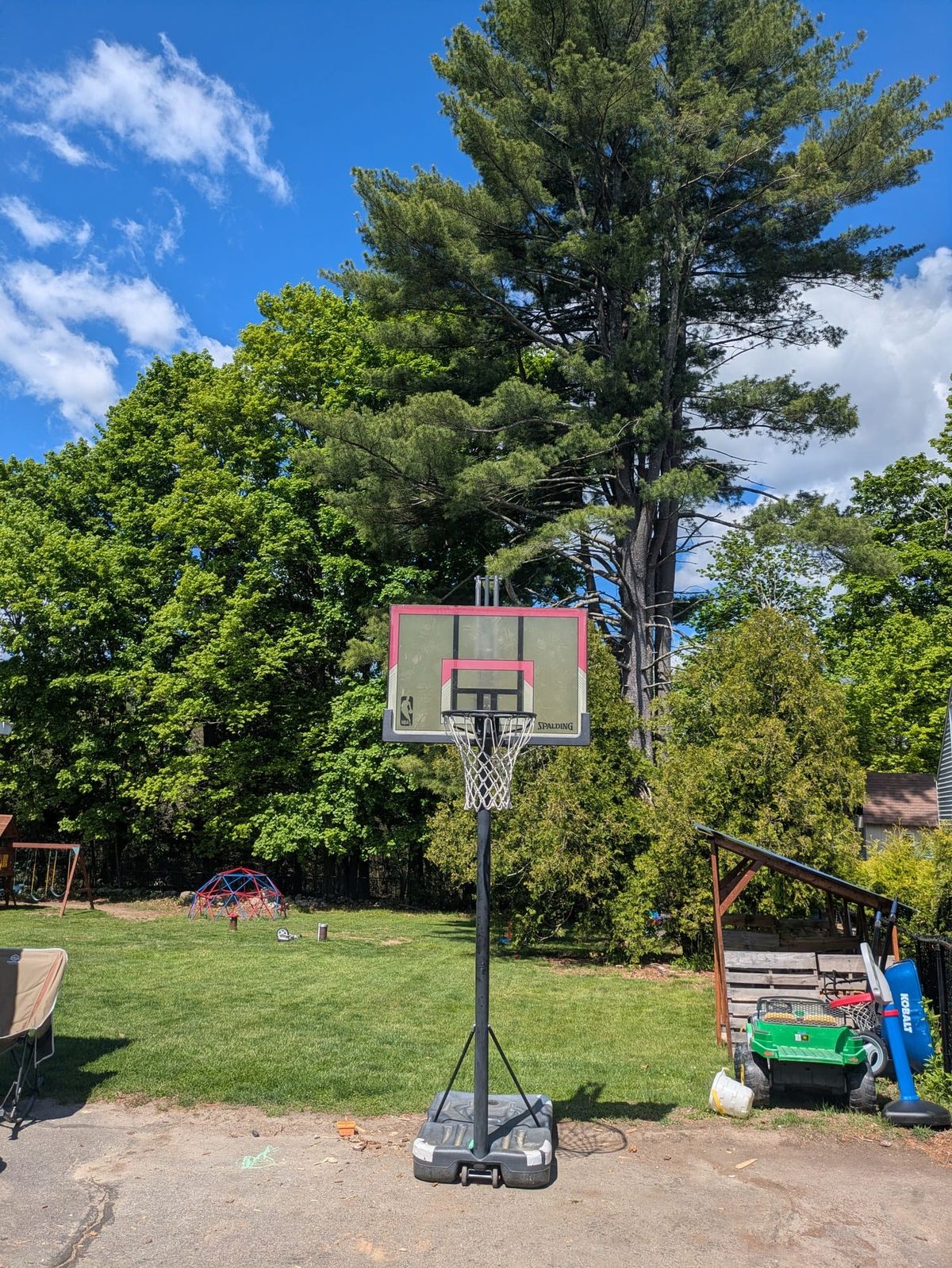
Then I went outside and shot around at the basketball hoop.
Around noon, by myself at first. I've done this since I was a kid. Just shooting, over and over, half mindless, the kind of repetitive thing that clears your head and lets you think. It's almost timeless. Then my youngest came out to join me. He's not quite three, so "join me" mostly meant hanging around and talking my ear off while I shot (he's become quite the talker, like his old man).
A Thursday. Summer. The middle of the day. Outside, not behind a desk, with my son.
And I felt physically free. Like it was my first day out of corporate all over again. The thought that landed was, holy shit, I was almost back in the arena. Back in the commute. Back in the hustle. This job would've been gentler than corporate, sure. But it was still a pull away from home.
I'd just turned down something I genuinely wanted, and I felt euphoric. A new lease on life. Or more accurately, a new lease on my FI life. Getting that close to the five-day schedule and the commute reminded me exactly what I'd have been handing back.
So why was I applying for a job at all, if I'm financially independent?
Fair question. Somebody's reading this thinking, wait, I thought you were financially independent. Was that a lie? Did the plan fall apart?
No. Financial independence doesn't mean I have to make deliberately bad money decisions just to prove I never have to work again.
Our cash runway is getting lower. Low enough that the next step would be selling investments to keep it going. And right now the crypto market is weak. Maybe this is the bottom, maybe it isn't. Only hindsight gets to know that. But I'd rather earn income than sell assets at a price I think badly undervalues them. That's a business decision as much as a lifestyle one.
Going back to work wouldn't erase what we've already built. We hit the finish line. I stepped away from corporate, found out what life looks like on the other side, took a real break, got present with my family, and had the freedom to turn down a job that wasn't right for us.
That is financial independence. Not a vow never to earn another dollar. Work is a lever. If the market's down and selling feels dumb, I can work for a while. If it turns around, maybe I won't have to. If it doesn't, I earn, I give the investments time, and I walk away again when selling actually makes sense. That's not failure. That's using every option I've got.
The job I actually take next probably won't look like URI. More likely a remote corporate role that pays a lot more and comes with a lot more of the grind. The community and the sense of purpose won't match what I felt on that campus. But the money and the flexibility might make more sense for us.
Remote keeps the commute at zero. I can still help with breakfast, throw in a load of laundry, do the dishes at lunch, get dinner going while I close out the day. If I'm going to trade a real chunk of my time, the paycheck has to earn it. A bigger income might even mean a babysitter now and then. The boys are getting older, it's getting more realistic, and it might buy Melissa and me some time together, which we almost never get.
Work a year or two, or until the market recovers. Then, when our assets are being valued like I think they should be, sell some and go back to the no-job version.
There's a book called Retire Often that's stuck with me. The gist is that life doesn't have to run in one fixed sequence. Grind for forty years, retire once, and hope you've still got the health and the energy left to enjoy it. Work and rest can come in seasons instead. Work, step away, live differently, come back, try something new, step away again.
My time off hasn't really been a retirement. It's been a sabbatical. A chance to recover from the last job while I figured out what a second act might look like. Going back to work wouldn't mean this stretch failed. This stretch already worked. I got out of a job I didn't want, spent real time with my family, rediscovered my creativity and how much I love to read and write, and found out I have more options than I thought.
That's the part I'd say to anyone close to FI who keeps moving the goalpost. There's always a reason for one more year. A bigger cushion, another milestone, one more variable to nail down. But if you've done the work, you know your numbers, and you've built real flexibility into your life, it might be okay to step away before everything's perfect. There are other jobs. It's not one irreversible door. You can take a break, live some life, learn something about yourself, and go back later knowing more about what you want.
I just lived that. I stepped away, went through another interview process, got a real offer, and had the freedom to say no because it wasn't right for my family. Turning down an offer can feel like a power move, and maybe it is a little. But the better point is that FI let me look at it honestly. I didn't have to force the numbers. I didn't have to pretend the commute didn't matter, or that my time was worth less than it is. I could just say, this is a wonderful opportunity, and it's not the right one for us.
Here's the thing underneath all of it, though.
Even a great life turns normal. FI takes away the commute, the meetings, the Sunday night dread, the calendar chaos, all the usual workplace nonsense. At first the freedom feels enormous.
Then it becomes just another day.
Being home becomes the baseline. Owning your schedule becomes normal. You stop waking up amazed that you don't have to drive anywhere or sit through another status update. The freedom is still there, and I don't take it for granted. But raising three young kids is relentless, and it's hard to feel the thrill of a free afternoon when you're refereeing a fight over a toy truck. The novelty fades. The gratitude stays. The buzz just wears off.
So how do you keep it feeling like something special? How do you stay grateful once the extraordinary turns ordinary?
Apparently one way is to have a near-job experience.
Maybe people who reach FI should go through an interview process every now and then. Not to take the job. Just to get close enough to remember. Get the offer, sit with the trade-offs, picture the schedule and the commute and every family moment you'd miss, and let it make your freedom visible again.
I got close. Close enough to feel the mornings and the evenings I'd lose. Then I said no, walked outside, and shot around with my kid.
For the first time in a while, my ordinary life didn't feel ordinary.
I'll probably still go back. Unless the market turns around soon, I almost certainly will. But the next job has to earn its place in our lives.
Until then, I'm outside shooting around with my kids.