Magic Beans
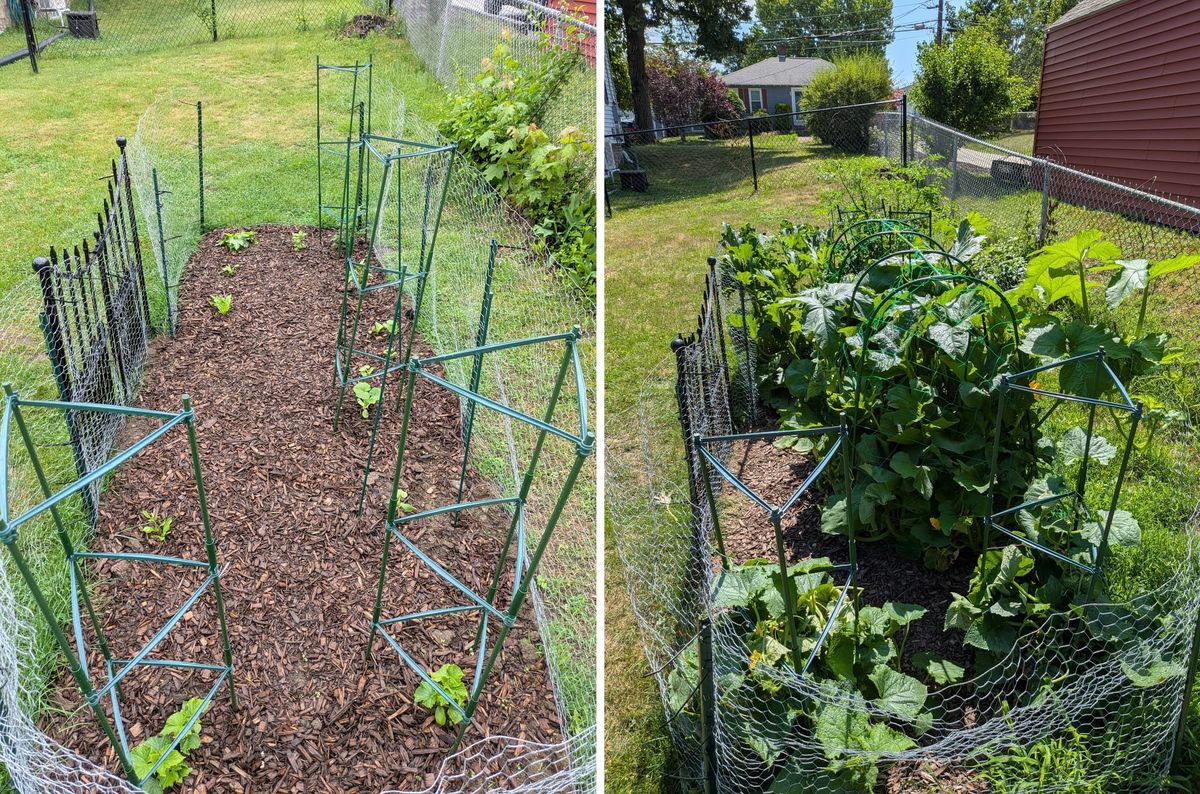
This spring I planted a garden where the chicken coop used to be. I want you to sit with that sentence for a second, because I didn't. Years of chickens doing what chickens do, plus a fresh layer of good topsoil on top. I basically planted vegetables in rocket fuel.
And I did everything right. Or at least everything that looked right. I turned the soil. I cut out an extra foot of yard just for the garden. I put up a chicken wire fence all the way around, zip tied it to the poles, even built a little gate so we could get in and out. I asked AI how much space each plant needed and laid everything out nice and clean. Everything had room. It looked like a diagram.
For about three weeks.
The zucchini went first. The leaves came in huge. Me and the boys call them solar panels, because that's what they are, the biggest leaves I've ever seen in a garden. And my reaction was pure pride: woah, we're growing something. Then the leaves kept coming, and kept stretching, and somewhere in the back of my head a quiet voice said we're not gonna have enough room here. I ignored it. Look at those leaves.
Then the Kentucky Wonder pole beans woke up.
If you've never grown pole beans, they send out these little shoots that work like grabber arms, wrapping around anything they touch. Mine grabbed the netting I eventually put up. Then the tomato cages. Then the fence. One of them is currently reaching across the garden toward the property fence, which is three or four feet away, like it has somewhere to be. We call it Jack and the Beanstalk. I'm fairly sure we planted magic beans by accident.
It was funny right up until the beans started reaching over the green pepper plant and shading it out. I'd pull them back in the morning, and by the next morning they'd be right back over it, like a big brother holding something over a little brother's head. And somewhere in the middle of all that, our little basil plant quietly got smothered between the zucchini and the tomatoes. We didn't even notice until it was gone. (RIP basil. You had plenty of room on the diagram.)
Here's the thing though. It's not that I skipped the boring work. I put in real work up front, and I was proud of it. The problem is I thought the boring work was the setup. Turn the soil, build the fence, put in the cages, done. Now we just water and collect vegetables.
But the setup was never the boring work. The boring work was the part nobody puts on a diagram. Walking the garden once a week and actually looking. Making sure each plant was growing into its structure instead of just growing under it. Pruning things while they were still small enough that cutting them didn't feel like a loss.
That last one got me. By the time I accepted that things needed to be cut, I was so proud of the growth that cutting anything felt like hurting the garden. So I waited. And because I waited, I ended up cutting way more than I would have if I'd started early. That's the catch-up tax. The boring stuff early is cheap. The same stuff late costs you limbs.
If you've read anything else on this blog, you can see where this is going. This is compounding. Small boring effort early, tremendous payoff later. Skip it and you can still recover, but it's messier, and you lose things you'd rather have kept. And here's the part I keep laughing at: I know this lesson. I built my entire financial life on this lesson. I write a blog about this lesson. And I still had to relearn it from a zucchini.
It's not just money, either. I think about the boys, and what the boring, beautiful parenting is that we don't even know we're skipping right now. The stuff we'll look back on in twenty years and think, oh man, we should have been doing that the whole time. You don't know what you don't know. You have to live through some of it.
Unless you know someone who already has.
My next door neighbor Michelle is a real gardener. Raised beds, a properly built fence, schedules for everything. She's retired, and the garden is part of her daily routine, right after the chickens. And here's what I notice when I watch her: she goes out with a mission, does her thing, and leaves. She doesn't look like she's learning anything out there. I mean that as the highest compliment. She's run this experiment for enough seasons that all the trial and error has been squeezed out of it. It's down to a boring, beautiful science.
Meanwhile I go out every morning and stare at my garden like I'm trying to understand it. Because I am.
My grandmother was that kind of gardener too. She planted peppers and tomatoes in the strip between the yard and the driveway, and kept a big garden a few houses down, at the property where my dad lives now. I remember picking vegetables out there as a kid. I was too young to actually learn anything from her before she passed. I just got to eat the results of somebody else's boring seasons.
And that's the part of this that sticks with me most. I had AI in my pocket when I planned this garden. I typed in my plants and got a tidy spacing chart back, and it felt like knowledge. But I guarantee that if I had walked Michelle over to that plot before I put a single seed in the ground, she would have looked at it for about four seconds and said, "I don't think you're gonna have enough room."
For most of human history, that's what elders were. The knowledge centers. You didn't search for the answer, you walked next door and asked somebody who'd already lived it. Our generation has so much information at our fingertips that we quietly assume we're smarter than everyone, including the people who've actually run the experiment. We're not. We just have better diagrams.
Next year I'll be more prepared. More organized. Actually willing to do the boring stuff early, because now I know what it is and what it buys.
But before anything goes in the ground, Michelle's looking at the plot first.